You need to drive one or more external monitors
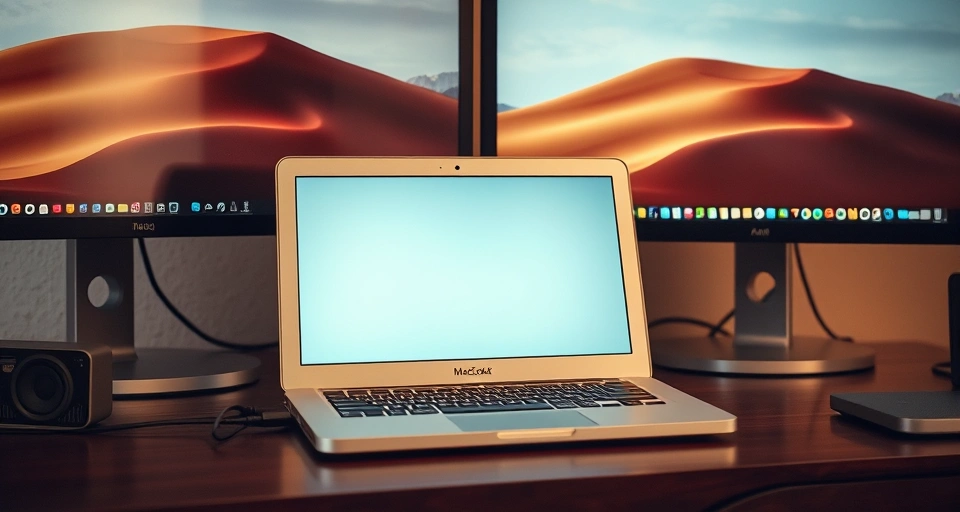
If your work involves plugging into one or more monitors, check display support before anything else about the MacBook Air — it's the one spec that decides whether the laptop fits your desk setup at all, and it's fixed at purchase.
External display support differs by Apple silicon generation, and the exact number of monitors and their resolution ceiling is listed under "Video Support" or "Display" on each model's own tech specs page rather than in general marketing copy. The MacBook Air 13-inch with M4 publishes its own external display figures on Apple's support site, and those figures are specific to that chip generation — they don't carry over from earlier Intel models or forward to newer ones automatically. The 2018 Retina MacBook Air and 2020 Retina model each list separate display specifications of their own, and none of the three pages should be assumed to match another.
To find the exact figure for a given machine:
- Identify the model year — either from the box, an About This Mac lookup, or the model number stamped on the case.
- Open that year's tech specs sheet on Apple's support site (the general specs page links out to each generation).
- Look under "Video Support" or "Display" for the exact external monitor count and resolution ceiling for that specific chip.
- Match that number against how many monitors you actually run day to day, including whether you need the built-in screen active at the same time.
- If your setup needs more displays than a given generation supports, rule that generation out immediately — a dock won't add capability the chip doesn't have.
Display capability is the spec most likely to be assumed rather than checked, and it's also the one that can't be upgraded later. A buyer who skips this step and discovers afterward that their two-monitor home office won't work is stuck — there's no external GPU or adapter workaround that restores capability the silicon doesn't have.
The built-in panel itself is worth understanding on its own terms, separate from external displays. Apple markets the 13-inch Air's screen as a Liquid Retina display, a term that on Apple's spec sheets refers to a specific resolution, pixel density, and brightness rating rather than a marketing label with no fixed meaning — each generation's tech specs page states the exact figures for that model, and they're worth comparing directly rather than assuming "Retina" means identical panels across years. For most everyday tasks — text, browsing, video, spreadsheets — the built-in panel is the more important screen day to day even for buyers who also dock to an external monitor, since it's the one they'll be looking at while the laptop is closed-lid or on the move.
Apps run slowly or storage fills up
If your current machine is grinding through browser tabs or constantly warning about disk space, the fix on a MacBook Air isn't a later upgrade — it's a decision you make once, at checkout. Unified memory and SSD storage are both fixed at the time of order and cannot be added to afterward, unlike a desktop where you might swap a stick of RAM or drop in a bigger drive.
That makes the memory and storage tier the single most consequential choice in the buying process, arguably more consequential than which chip generation you pick, since a slower chip can be worked around while a full drive or exhausted memory pool cannot. The current 13-inch Air is configurable across multiple memory and storage tiers at checkout, and the specific M5 configuration Apple sells directly pairs a 10-core CPU with an 8-core GPU, 16GB of unified memory, and 512GB of storage — one configuration among several Apple offers, not necessarily the only one available at that price point, so the specific pairing on that page should be checked against the current configuration list rather than assumed to be the entry point for the whole line.
Core counts matter beyond the headline number. A 10-core CPU handles more simultaneous background processes and multitasking without slowdown than fewer cores would, and the paired GPU core count — 8-core in that configuration — determines how well the machine handles graphics-heavy work like video export, 3D rendering previews, or gaming at higher settings. Apple sells configurations with different CPU and GPU core counts within the same chip generation, so two Airs with the same chip name can perform differently depending on which core configuration was selected at order time.
Before ordering, work backward from what actually fills a drive or strains memory:
- Video editing, large project files, or local photo libraries push storage down fast — 512GB is a reasonable floor, not a ceiling, for that kind of use.
- Dozens of open browser tabs alongside creative apps benefit more from extra memory than extra storage.
- Light use — email, documents, streaming — rarely stresses either the base memory or base storage tier.
- Anyone planning to keep the machine five-plus years should size up on both, since neither can be added later at any price.
The Apple Store configuration page for the 13-inch Air is where this decision actually gets locked in — treat that page as the point of no return rather than a formality to click past. Once the order ships, the only ways to change memory or storage are to sell the machine and buy again, or to add an external drive that doesn't touch the internal SSD's performance ceiling.
Battery capacity works the same way — it's fixed at manufacture, not configurable, but it's still worth checking against your actual routine before buying. Apple's tech specs page for the M4 model lists rated battery life separately for tasks like video playback and wireless web browsing, and those two figures are usually different from each other because they represent different workloads. Rated hours are measured under specific test conditions Apple defines on that page, and actual runtime for a given buyer will vary depending on screen brightness, network activity, and how demanding the open apps are — someone editing video or running multiple browser tabs with several tracker-heavy sites open will see meaningfully shorter runtime than the rated figure, even on the same machine.
You are unsure how old a given 13-inch MacBook Air is
If you're looking at a used or hand-me-down MacBook Air and don't know its age, the model year is the fastest way to answer nearly every other question about it — chip generation, expected software support, and whether it's worth buying or keeping. Apple has sold 13-inch Air models spanning a wide stretch of years, from the Retina-era Intel machines through several generations of Apple silicon.
Two spec sheets bookend the older side of that range: the 2018 Retina MacBook Air and the 2020 Retina MacBook Air, both still documented on Apple's support site with their exact model identifiers and configurations. The current end of the range is the MacBook Air 13-inch with the M4 chip, alongside the M5 configuration Apple currently sells through its store.
| Generation | Chip family | Where to confirm |
|---|---|---|
| Retina 13-inch, 2018 | Intel | Apple tech specs |
| Retina 13-inch, 2020 | Intel (with an Apple silicon M1 variant released the same year) | Apple tech specs |
| 13-inch, M4 | Apple silicon | Apple tech specs |
| 13-inch, M5 | Apple silicon | Apple Store configuration |
To pin down which one you have, check either the model number stamped on the underside of the case or the "About This Mac" panel on the machine itself, then match the chip and year listed there against Apple's tech specs pages. An Intel-based 13-inch Air is meaningfully older than any Apple silicon model — it runs a different chip architecture entirely, which affects both performance and how many more years of macOS updates it's likely to receive. If the machine you're looking at is Intel-based, weigh its age against how much longer you need it to run current software before deciding it's worth buying or holding onto; if it's already on Apple silicon, the chip generation and memory/storage tier matter more than the calendar year.
Sleep or shutdown: does it matter for an older Air
Nightly habits matter more on an aging battery than on a new one. A lithium-ion battery in either an Intel or Apple silicon Air degrades gradually through normal charge cycles regardless of whether the lid is closed to sleep or the machine is fully shut down each night, so neither habit by itself prevents wear. For daily use, leaving the machine to sleep overnight is generally fine and gets it back to a working state faster the next morning, since sleep keeps a small trickle of power flowing to preserve open work rather than closing everything out. A full shutdown once every week or two, rather than every single night, is a reasonable middle ground for anyone who notices the machine slowing down over time or wants to clear background processes without losing the convenience of sleep on ordinary days. On an older Intel-era Air already several years past its release, that distinction matters less than the chip generation and remaining software support — a battery habit doesn't restore performance a dated processor no longer has.
You are choosing between 13-inch and 15-inch Air
If you're torn between screen sizes, know first that the decision doesn't touch chip, memory, or storage — Apple offers both the 13-inch and 15-inch Air with the same configuration options at each tier. The difference that actually matters is screen size and the weight and footprint that come with it.
That means the choice reduces to a single question: how much of your day happens on the built-in panel versus an external display. Someone who plugs into a monitor at a desk most of the time and only uses the laptop screen while traveling gains little from the larger panel and carries extra bulk for no benefit. Someone who works entirely off the built-in display — no desk setup, no external monitor — gets real, daily value from the 15-inch screen's extra size, since that's the only screen they'll ever look at while using the machine.
Portability cuts the other way. A 13-inch Air is lighter and smaller in a bag, which matters most for anyone who moves between locations often — commuting, traveling, working from different rooms or buildings through the week. If most of your computing happens sitting in one place at a desk, that portability advantage doesn't get used, and the 15-inch panel's extra size becomes the deciding factor instead.
Run through it this way before deciding:
- If you dock to an external monitor most of the day, default to the 13-inch and save the weight.
- If the built-in screen is your only screen, lean 15-inch for the larger canvas.
- If you're frequently moving locations with the laptop, weight and size favor the 13-inch regardless of how you use displays at your desk.
- If none of that resolves it, the chip, memory, and storage decisions covered above matter far more to daily performance than the two inches of screen size do.
Once you've matched screen size to how you actually use a display, the remaining decision is the same one covered earlier: which memory, storage, and core-count tier to lock in at checkout, since those choices — not screen size — are the ones you can't revisit later.